The quarterback is arguably the most important position in all of sports. The fate of an NFL franchise rests entirely on the shoulders of the player taking the snaps. Over the last three decades, the way the quarterback position is played has drastically changed.
If you play Weddle Unlimited, you probably already know that knowing the age, height, and jersey number of modern quarterbacks is essential for winning the game in under 5 guesses. Let's take a look at how the quarterback position evolved, and how it impacts your Weddle strategy today.
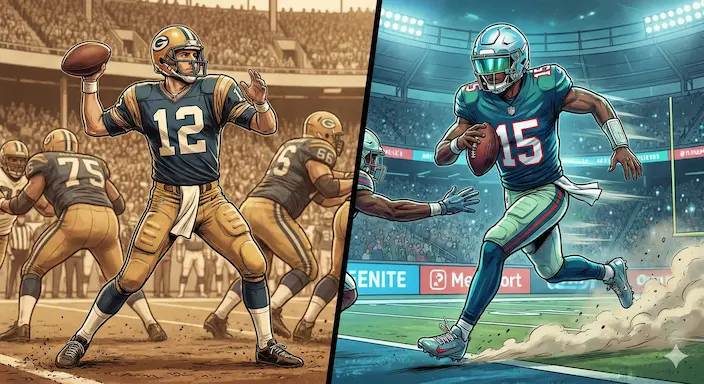
The Era of the Pure Pocket Passer
For the vast majority of NFL history, the golden rule for a successful quarterback was simple: stand tall in the pocket, survey the field, and deliver an accurate strike.
Quarterbacks like Dan Marino, Peyton Manning, and Tom Brady exemplify this era. These players were essentially coaches on the field. They weren't known for their foot speed (Tom Brady’s famously slow 40-yard dash time is still a meme today), but their minds operated faster than any linebacker could run.
The prototypical pocket passer was usually exactly 6'4" or 6'5". In Weddle Unlimited, if you see a mystery player who is a QB and they are over 35 years old (or retired if you are playing older versions), their height is almost mathematically guaranteed to be exactly 6'4" or 6'5".
The West Coast Offense and The Move Concept
As defensive linemen like Reggie White and Lawrence Taylor became faster and more terrifying, standing still in the pocket became a dangerous game. Coaches like Bill Walsh popularized the West Coast Offense with Joe Montana, focusing on quick, rhythmic passing that required the quarterback to roll out of the pocket to create space.
This paved the way for players like Steve Young and John Elway, who were athletic enough to extend plays with their legs, though passing was still their primary weapon.
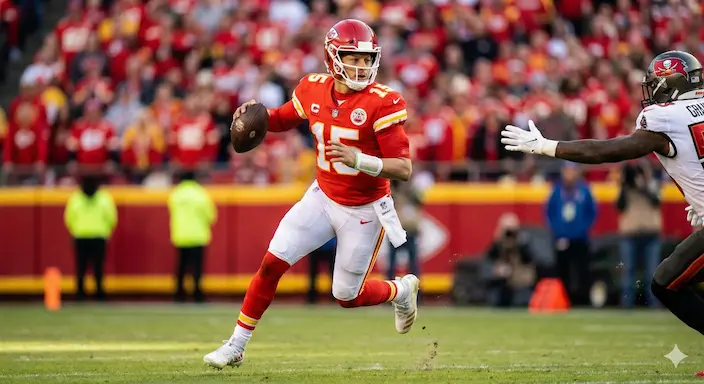
The Dual-Threat Revolution
The mid-2000s saw the arrival of a new weapon: the true dual-threat quarterback. Michael Vick shattered the mold of what a quarterback looked like. Vick was the fastest player on the field, capable of outrunning defensive backs, yet possessed a cannon of a left arm.
This evolution culminated in today's NFL, which is dominated by players who can beat you with both their arms and their legs.
- Lamar Jackson: The master of the designed run, an elusive MVP who jukes defenders out of their cleats.
- Josh Allen: A 6'5", 237-pound tank who casually hurdles linebackers and throws the ball 70 yards downfield.
- Patrick Mahomes: The modern standard. Not a pure runner like Jackson, but the undisputed master of unscripted plays, side-arm throws, and scrambling just long enough to break a defense's heart.
How the QB Evolution Affects Weddle Strategy
Because the dual-threat quarterback doesn't need to stand perfectly still and see over the offensive linemen as much, the physical profile of an NFL quarterback has become significantly more diverse.
When guessing QBs in Weddle, remember these traits of the modern QB landscape:
- Height Diversity: You no longer have to be 6'4" to play the position. Kyler Murray (5'10"), Russell Wilson (5'11"), and Bryce Young (5'10") prove that shorter, shiftier players are highly valued.
- Jersey Numbers: Historically, QBs stuck to numbers 1-19. Today, those numbers are heavily shared with wide receivers (who now wear single digits). If you get a green hit on a number under 19, don't automatically assume it's a QB.
- Age Demographics: The age of the starting NFL quarterback has dropped significantly. Teams are relying heavily on rookie contracts, meaning a large portion of starting QBs are under 26 years old compared to 15 years ago.
Who Will Be the Next Evolution?
As defenses adapt with faster linebackers and complex disguised coverages, what will the quarterback of the 2030s look like? Only time will tell. Until then, brush up on your roster knowledge and see if you can guess today's mystery QB!
Ready to play? Guess the mystery player today at Weddle Unlimited!